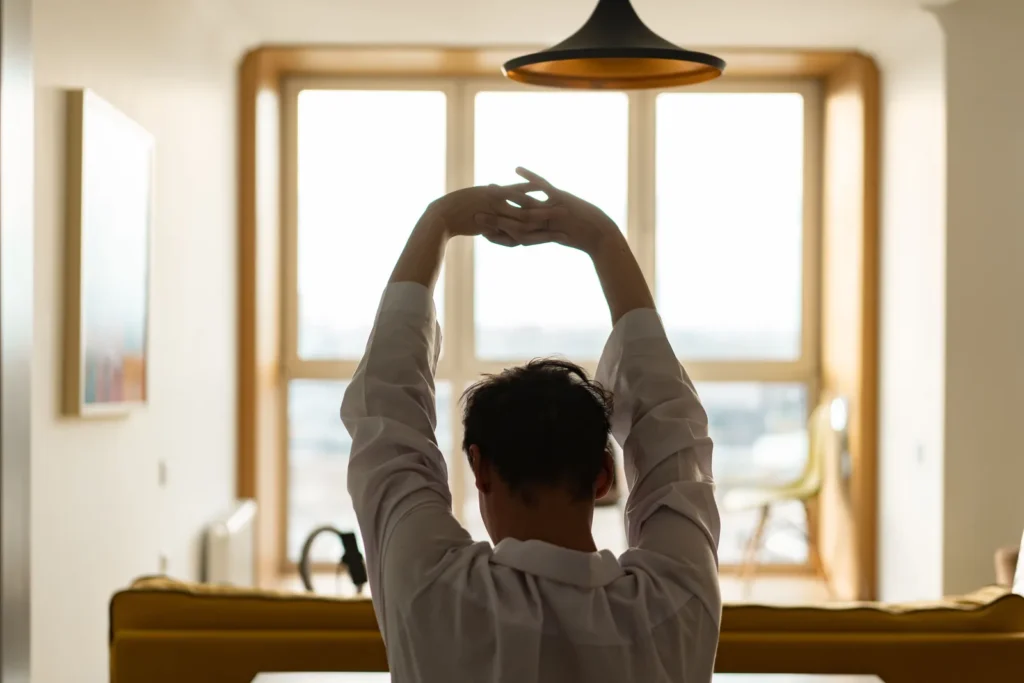
You finish a late workout feeling productive, take a shower, and then lie in bed with your mind awake and your body still running hot. Does that mean exercise before bed is always a bad idea? No. The better question is what you did, how hard you worked, when you stopped, and how your own sleep responded.
For men over 40, evening exercise can be the only realistic option after work and family responsibilities. Walking, mobility work, moderate lifting, and all-out intervals do not create the same recovery demand. Instead of banning nighttime exercise, use timing and intensity to build a cutoff that fits your body and schedule.
Medical Disclaimer: This article is for educational purposes only and is not medical advice. It cannot determine why you have persistent sleep problems or whether a workout is appropriate for your health. Ask a qualified health care professional about exercise if you have heart or lung disease, diabetes, uncontrolled blood pressure, major joint problems, concerning symptoms, or a long period of inactivity.
Does Evening Exercise Automatically Disrupt Sleep?
The simple rule that “exercise at night ruins sleep” is not supported across every type of workout. A 2019 systematic review and meta-analysis by Stutz, Eiholzer, and Spengler included 23 studies of healthy adults. Overall, a single evening exercise session did not worsen sleep. The authors did, however, identify a reason for caution: vigorous exercise ending within one hour of bedtime might delay sleep onset and reduce total sleep time and sleep efficiency.
A larger 2025 study by Leota and colleagues adds useful context. The researchers analyzed wearable data from a large group of physically active adults across millions of person-nights. Later workouts and greater exercise strain were associated with later sleep onset, shorter sleep, lower sleep quality, a higher nighttime resting heart rate, and lower heart-rate variability. Sessions that ended at least four hours before sleep onset were not associated with those sleep changes.
Those results should not become a rigid four-hour rule for everyone. The 2025 study was observational, relied on one commercial wearable platform, and included people who exercised regularly. It found associations, not proof that a late workout caused every sleep change. The 2019 review also focused on healthy participants and mostly examined a single exercise session. Together, the studies support a practical conclusion: the harder and later the workout, the more recovery time you may need.
The Three Variables That Matter Most
How close the workout ends to bedtime
Count backward from the time you actually try to sleep, not from the time you start getting ready for bed. A workout that ends at 8:30 PM has a different context for someone asleep at 10 PM than for someone asleep at midnight.
Finishing close to bedtime leaves less time for heart rate, body temperature, alertness, and the normal post-workout routine to settle. It may also push dinner, bright-light exposure, showering, and phone use later. If your schedule is tight, shortening or lightening the session may be more useful than dropping exercise altogether.
Exercise intensity
Intensity is not the exercise name alone. A brisk walk may be easy for one man and demanding for another. A strength session can be moderate when you leave several repetitions in reserve, or highly demanding when you train near your limit with short rest periods. Hills, heat, conditioning, illness, and accumulated fatigue can all change how hard the same session feels.
Use a simple effort scale from 1 to 10. Easy movement might feel like 2 or 3, moderate work like 4 to 6, and a demanding session like 7 to 9. You do not need laboratory numbers. The goal is to compare your own sessions consistently.
Duration and personal recovery
A long moderate workout can create more total strain than a short one. That matters because the 2025 study examined exercise strain, which reflects more than intensity alone. The researchers also noted that their heart-rate-based method may underestimate the demand of brief, high-effort strength training, so lifters should not assume a low wearable score tells the whole story.
Your response can also vary from night to night. Poor sleep the previous night, a stressful day, dehydration, heat, soreness, and stimulant use may extend the time it takes to feel settled. Look for repeated patterns rather than judging your schedule from one unusual night.
Walking, Mobility, Strength Training, and High-Intensity Workouts
Activities that are easier to wind down from
An easy walk, gentle mobility session, relaxed cycling, or light resistance work often creates less strain than intervals, hard running, or heavy training near muscular failure. These lighter options can be useful when evening is your only open window. Keep the session comfortable enough that you can speak in full sentences and finish feeling calmer rather than charged up.
Gentle movement can also become part of a broader transition out of the day. If you want a structured sequence after a light session, the Evening Reset routine offers a practical framework for dimming stimulation and preparing for bed. The purpose is not to make every evening identical; it is to give your body a clear change of pace.
When a hard session may leave you alert
High-intensity intervals, long endurance sessions, competitive games, and demanding strength workouts can keep heart rate and perceived alertness elevated. The 2019 review found that vigorous exercise ending within one hour of bedtime was the clearest situation in which sleep could be impaired. The 2025 wearable study likewise found that later timing and higher strain were the more disruptive combination.
If you feel “wired but tired” after late training, do not assume that motivation or discipline is the problem. Record the workout and change one variable. Our guide to feeling wired but tired at night explains other evening factors that can produce a similar pattern.
Build a Personal Exercise Cutoff
Start with the most demanding sessions. If possible, place hard intervals, long runs, competitive training, or heavy lifting at least several hours before your intended sleep time. The 2025 study suggests four hours as a useful conservative starting point for reducing the chance that high strain and late timing overlap. It is not a medical threshold, and a lighter session may require less separation.
When you must train later, reduce one part of the dose. Use fewer intervals, stop a strength set with repetitions still available, shorten the session, or replace hard conditioning with easy walking and mobility. End with a gradual cool-down instead of moving directly from peak effort to bed.
Move your cutoff earlier if you repeatedly take longer to fall asleep, wake feeling overheated, notice a racing heartbeat at bedtime, or sleep less after a particular session. Move it later only when several comparable nights show that sleep remains stable. Your schedule should be based on repeatable evidence from your life, not a single social-media rule.
A 7-Night Exercise-and-Sleep Log
A short log can separate a timing problem from a random bad night. Use seven nights as a first pass, then extend the test if your workouts vary widely. Do not chase perfection; look for a pattern strong enough to guide the next week.
Keep caffeine, wake time, and naps stable
Try to keep your wake time, afternoon caffeine, alcohol, and naps similar during the test. A late coffee or long nap can obscure what the workout did. If napping is part of your routine, use our guide to naps and nighttime sleep to keep the timing consistent.
Record workout end time, effort, and sleep pattern
- Workout type, start time, end time, and total duration
- Effort from 1 to 10 and whether the session felt harder than usual
- Caffeine, alcohol, late meals, and unusual stress
- Time you tried to sleep and your rough estimate of time to fall asleep
- Remembered awakenings, morning energy, soreness, and overheating
A wearable can add trends, but its sleep stages and readiness scores are estimates. Do not let one number overrule how you felt or determine whether you are safe to train. See how to read a sleep tracker without overreacting to one score.
After seven nights, compare similar sessions. Did demanding workouts within two hours of bed repeatedly delay sleep while easy walks did not? Did the same workout cause trouble only when paired with caffeine or a late heavy meal? Change one factor for the next week and repeat.
Recovery Factors That Can Confuse the Result
Heat, hydration, and late meals
A hot gym, warm bedroom, or hot shower immediately before bed can make a late session feel more activating. Give yourself time to cool gradually, change out of damp clothes, and make the bedroom comfortable. Drink enough across the day and replace fluids after training, but avoid forcing a large volume right before bed if bathroom trips already interrupt your sleep.
Post-workout hunger can also shift a large meal close to bedtime. If that seems to be part of the pattern, test a smaller, familiar meal and move more of your daily intake earlier. Men with reflux symptoms should be especially careful about lying down soon after eating; a clinician can help with persistent symptoms.
Stress and post-workout stimulation
The workout may not be the only stimulating part of the evening. Bright gym lights, loud music, competition, pre-workout products, work messages, and scrolling after training can all keep the day moving at full speed. Use the log to capture those details before blaming exercise alone.
Nutritional supplements are a separate decision from workout timing. They cannot substitute for changing an overly demanding late session, shortening a stimulating routine, or getting professional guidance for concerning symptoms. If you are considering broader nutritional support as one optional part of your evening routine, review the label and ingredients with a health care professional, especially if you use medication or manage a medical condition.
Affiliate Disclosure: This post may contain affiliate links. If you purchase through our links, we may earn a small commission at no extra cost to you. See our Affiliate Disclosure page for details.
When Poor Sleep or Exercise Symptoms Need Professional Attention
Talk with a qualified health care professional if sleep disruption persists, affects driving or work, or continues despite reasonable changes to timing and intensity. Also ask for guidance before starting vigorous exercise if you have a heart condition, diabetes, high blood pressure, significant breathing problems, or a long break from regular activity.
Stop exercising and seek prompt medical guidance for chest pain or pressure, dizziness, faintness, unusual shortness of breath, or a new irregular heartbeat during activity. Call 911 for severe or persistent chest discomfort, fainting, severe breathing difficulty, sudden weakness, or another possible emergency. Do not drive yourself when symptoms may be urgent.
The Bottom Line
Exercise before bed is not automatically bad. Easy and moderate activity may fit comfortably into the evening, while a demanding session close to bedtime is more likely to interfere with recovery and sleep. Timing, intensity, and duration matter together.
Start by giving hard workouts more space before bed. If late training is unavoidable, choose a lighter or shorter session and use a seven-night log to compare similar days. The best cutoff is the one that lets you train consistently without repeatedly sacrificing sleep.
References
- Stutz J, Eiholzer R, Spengler CM. Effects of Evening Exercise on Sleep in Healthy Participants: A Systematic Review and Meta-Analysis. Sports Medicine. 2019;49(2):269-287. doi:10.1007/s40279-018-1015-0.
- Leota J, Presby DM, Le F, et al. Dose-response relationship between evening exercise and sleep. Nature Communications. 2025;16:3297. doi:10.1038/s41467-025-58271-x.
- National Heart, Lung, and Blood Institute. Physical Activity and Your Heart: Risks. National Institutes of Health. Accessed October 28, 2026.
Affiliate Disclosure: This post may contain affiliate links. If you purchase through our links, we may earn a small commission at no extra cost to you. See our Affiliate Disclosure page for details.
Get the Free Evening Reset Checklist
Download our free Evening Reset Checklist — a simple 5-minute routine designed to help you wind down before bed.