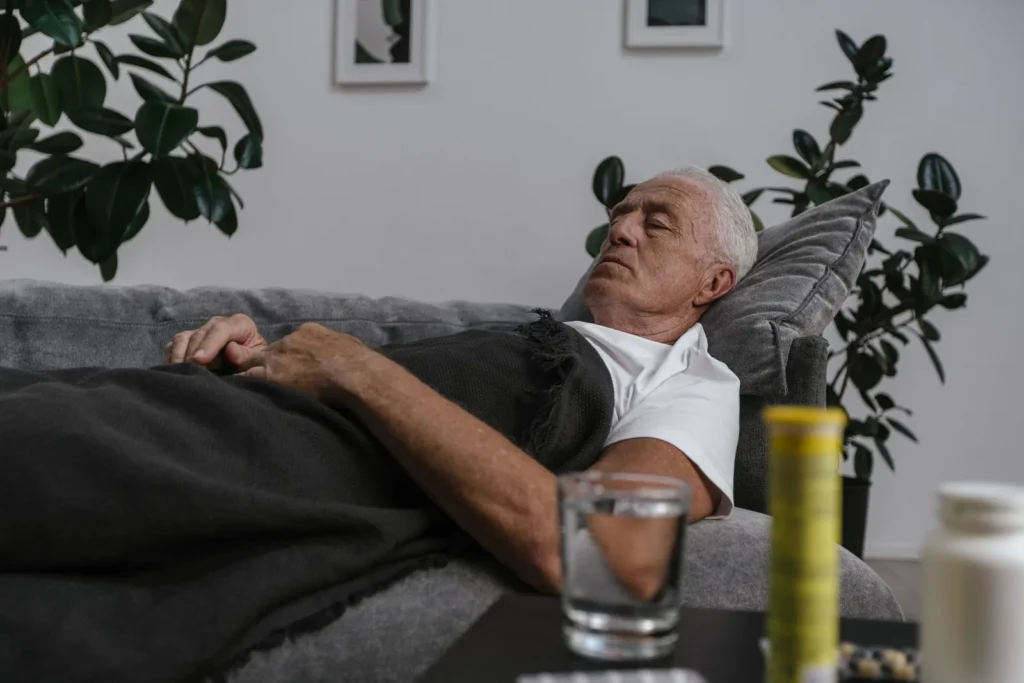
A nap can take the edge off a rough afternoon. It can also make bedtime feel strangely difficult. The difference often comes down to what kind of rest you took, when you took it, how long you actually slept, and whether daytime sleepiness is pointing to a larger problem.
For men over 40, the useful question is not “Are naps good or bad?” It is “What happens to my nighttime sleep when I nap in this specific way?” A short, early nap may be workable for one person, while an unplanned hour on the couch at 6 PM may keep another person awake well past bedtime.
Medical Disclaimer: This article is for educational purposes only and is not medical advice, diagnosis, or a substitute for care from a licensed healthcare professional. Persistent or dangerous daytime sleepiness can be related to sleep apnea, medication effects, insufficient sleep, or other health conditions. Do not drive or operate machinery when you are struggling to stay awake.
Why a Daytime Nap Can Change Nighttime Sleep
Sleep drive in plain English
Your need for sleep generally builds during the hours you are awake. Sleep clinicians often call this homeostatic sleep drive, or sleep pressure. The U.S. Department of Veterans Affairs CBT-I therapist manual compares it with hunger: the longer it has been since you slept, the stronger the drive tends to become.
Actual sleep reduces some of that pressure. That is why a nap can make you feel more alert afterward. It is also why a long nap, or even brief dozing close to bedtime, may leave less sleep drive available when you want to fall asleep at night. A nap does not automatically ruin sleep, but it changes one of the forces involved.
The natural afternoon dip versus true sleep debt
Feeling a dip in alertness in the early afternoon does not always mean something is wrong. Your circadian system, the internal timing process that helps organize sleep and wakefulness, often produces a natural afternoon lull. A heavy lunch or a warm, quiet room can make that lull more noticeable.
True sleep debt is different. If you regularly get too little sleep, work irregular hours, or have fragmented nights, you may be trying to repay a larger deficit. A nap may temporarily reduce sleepiness without addressing why you are not getting enough restorative sleep at night.
Planned Nap, Accidental Dozing, or Quiet Rest?
These three situations should not be logged as if they were identical:
- Planned nap: You choose a start time, set an alarm, and intend to sleep for a limited period.
- Accidental dozing: You fall asleep while watching TV, reading, sitting after dinner, or riding as a passenger. The duration may be longer than you realize.
- Quiet rest: You lie down or sit comfortably with your eyes closed but remain awake. This does not reduce sleep drive in the same way as actual sleep.
If you are unsure whether you slept, write “rested, sleep uncertain” instead of inventing a precise nap duration. A wearable may offer another clue, but consumer devices estimate sleep rather than directly diagnose it. Our guide to using sleep trackers without overreading the score explains how to focus on trends instead of one questionable data point.
Three Nap Variables That Matter
Duration
Longer naps remove more sleep pressure and make it more likely that you will enter deeper sleep. Waking from deeper sleep can also produce sleep inertia, the groggy, slow-to-start feeling that may last after you get up. If nighttime sleep is already difficult, an open-ended nap is harder to interpret than a brief, planned one.
Time of day
An early-afternoon nap leaves more waking time before bed. A late-afternoon or evening nap sits much closer to the sleep period you are trying to protect. Clock time is not the whole story, however. A 3 PM nap has a different relationship to bedtime for someone who sleeps at 9 PM than for someone who sleeps at midnight.
Frequency
An occasional recovery nap after an unusual short night is not the same pattern as falling asleep every afternoon. Frequent naps may be a habit, a response to chronic sleep restriction, an effect of medication or alcohol, or a clue that nighttime sleep is repeatedly interrupted. Frequency gives your clinician more useful context than the statement “I nap sometimes.”
When a Nap Is More Likely to Interfere With Bedtime
A nap deserves closer attention when it is long, happens late, occurs most days, or is followed by a clear change in your night. Watch for a longer time to fall asleep, less sleepiness at your normal bedtime, more time awake during the night, or a tendency to shift bedtime later.
Context matters too. If you nap after sleeping in, spend much of the day inactive, and then doze in front of the TV after dinner, several factors are reducing the contrast between day and night. If you had an unusually short night and take one controlled early nap, the result may be different.
Can a Short Early Nap Be Reasonable?
Possibly, but “short and early” is a starting point to test, not a universal prescription. A 2025 pilot study by Faraut and colleagues compared adults receiving CBT-I who reported naps with matched adults who did not. Participants who were permitted to nap were allowed less than 30 minutes in the early afternoon under specific clinical conditions. Both groups improved on several self-reported insomnia measures, with no significant difference in those improvements between groups.
That study does not prove that naps improve insomnia or that everyone in CBT-I should nap. The groups were not randomly assigned, sleep was measured with diaries rather than objective testing, and follow-up after the program was lacking. The authors explicitly called for larger studies using objective sleep measures.
If you are currently following CBT-I, sleep restriction, or another clinician-directed plan, do not add naps on your own because of one article. Ask the professional guiding your plan. If you are testing naps independently, keep the experiment conservative and stop if nighttime sleep consistently worsens.
A Seven-Day Nap and Nighttime Sleep Experiment
The goal is not to produce a perfect score. It is to see whether your nap pattern and nighttime sleep move together. Use paper, a notes app, or a simple spreadsheet.
Record when you actually slept
- Nap start and end time, plus whether the timing is exact or estimated
- Whether the nap was planned, accidental, or quiet rest without known sleep
- Sleepiness before and alertness after, each on a simple 0-to-10 scale
- Bedtime, estimated time to fall asleep, nighttime awakenings, and final wake time
- Caffeine, alcohol, unusual exercise, illness, or medication changes that could distort the comparison
Keep wake time and evening habits stable
Try to get up at the same time each day and keep your usual wind-down routine steady. If you change your wake time, caffeine, alcohol, exercise, screen use, and nap all at once, you will not know which change mattered. The same logic applies if your main issue is waking repeatedly: use our overview of common reasons men over 40 wake during the night rather than blaming the nap automatically.
Change only one nap variable
If your usual nap is 60 minutes at 5 PM, do not change both timing and duration on the same day. You might first move it earlier while keeping the planned duration stable. Or you might keep the early timing and shorten the nap. Compare several nights, not one. Stress, pain, noise, and chance can all disrupt a single night.
If you rarely nap and nighttime sleep is already satisfactory, there is no need to start. If you are severely sleep deprived, a self-experiment should not replace adequate sleep or a medical evaluation.
Sleepiness and Fatigue Are Not the Same
Sleepiness is the tendency to fall asleep. Your eyelids feel heavy, your head nods, or you lose the thread of a conversation. Fatigue is low energy, exhaustion, or reduced capacity without necessarily being able to sleep. You can feel both, but the distinction helps narrow the next step.
Quiet rest may help when you feel mentally drained but not sleepy. Repeated involuntary dozing is different. It deserves attention because a nap can conceal the symptom for a few hours without revealing its cause.
When Daytime Sleepiness Needs Professional Evaluation
Schedule a healthcare visit if sleepiness is persistent, worsening, new, or interfering with work, relationships, or safety. Bring your seven-day log and a current medication list. Prescription drugs, over-the-counter sleep aids, antihistamines, alcohol, and other substances can affect alertness, but do not stop prescribed medication without professional guidance.
Ask about a sleep evaluation if daytime sleepiness comes with loud snoring, witnessed pauses in breathing, gasping, dry mouth, morning headaches, or frequent nighttime urination. The NHLBI lists breathing that starts and stops, loud snoring, gasping, and daytime sleepiness among possible sleep apnea symptoms. Our comparison of insomnia and sleep apnea signs in men over 40 can help you prepare useful questions, but only a qualified professional can evaluate the pattern.
Do not drive through severe sleepiness. If you begin nodding off behind the wheel, pull over somewhere safe and arrange another way to travel. Seek urgent medical help for sudden sleepiness with confusion, weakness, trouble speaking, chest pain, severe shortness of breath, or another acute symptom.
Keep Your Evening Routine Stable While Testing Naps
A nap experiment works best against a stable background. Keep your usual wake time, evening light exposure, caffeine cutoff, and bedtime routine as consistent as practical. If the evening itself is chaotic, start with a repeatable five-step evening routine and track that separately.
If stress-related evening tension is a separate part of your pattern, some people also consider nutritional supplements as optional wellness support. A supplement cannot correct a late nap, diagnose a sleep disorder, or replace adequate sleep and professional care. CortiSync is presented here only as a commercial option for readers who want to review it, not as a solution for insomnia, excessive sleepiness, or sleep apnea.
Affiliate Disclosure: This post may contain affiliate links. If you purchase through our links, we may earn a small commission at no extra cost to you. See our Affiliate Disclosure page for details.
The Bottom Line
Yes, naps can affect sleep at night because actual daytime sleep reduces some of the sleep pressure you build while awake. Duration, timing, and frequency all matter. Long, late, or accidental naps are more likely to compete with bedtime than a brief, planned nap early in the afternoon, but individual responses vary.
Test one variable for seven days, keep the rest of your routine steady, and watch patterns rather than chasing a perfect night. If you are repeatedly dozing without intending to, struggling to stay awake while driving, or noticing snoring and breathing pauses, move the focus from nap optimization to professional evaluation.
References
- Manber R, Friedman L, Siebern AT, et al. (2014). Cognitive Behavioral Therapy for Insomnia in Veterans: Therapist Manual. U.S. Department of Veterans Affairs.
- Faraut B, Gaillard L, Labonne A, Dubois JM, Adrien J, Léger D. (2025). Napping during cognitive behavioural therapy for insomnia: Friends or foes? Journal of Sleep Research, 34(2), e14343.
- National Heart, Lung, and Blood Institute. (2022). Sleep Deprivation and Deficiency.
- National Heart, Lung, and Blood Institute. (2025). Sleep Apnea Symptoms.
Affiliate Disclosure: This post may contain affiliate links. If you purchase through our links, we may earn a small commission at no extra cost to you. See our Affiliate Disclosure page for details.
Download our free Evening Reset Checklist — a simple 5-minute routine designed to support a calmer wind-down before bed.